Share:
Copy link
Copied!

If you go to a game, at any level, you can hear just about anything from the crowd, as they praise and condemn the athletes. Common verbiage from the fans is “He’s a beast!” or “She is a tough as nails!” or “He is unshakeable!” Sadly, there is another side of the coin where you may hear “Looks like Tarzan, plays like Jane!” or “Her head is not in the game today.” or “This Bumb has no skills.”
With their words, the crowd is saying they can recognize performance variables in athletes by their demeanor and play while competing. A performance variable is any measurable factor that can increase, or decrease, player performance. This list of variables is limitless, but more common performance variables are a) training intensity; b) organic issues; c) self-efficacy; d) external influences e) coaches; and f) parents (Jianjun et al., 2025; Yang, Xu & Lu, 2024).
Performance Variables
There are many variables that go into sculpting the perfect athlete. For example, if you wanted to make the perfect basketball player comprised of 1) athleticism; 2) size and strength; 3) will-power; 4) on-court IQ; 5) off the court discipline; 6) activism in the community; and 7) biggest heart. You’ve probably already named 7 different athletes to build this perfect athlete; yet, if these are important for this fictious athlete, how do we maximize each category in each individual athlete to be well-rounded from the start?
Many coaches today state that the children are so athletic, but more interested in social media followers. So much so that they have lost sight of learning the fundamentals while creating content for TikTok and IG highlight reels. This problem begins with the current athletic training system. There needs to be a paradigm shift to strengthen the performance variables that matter on the court; and it begins with parents and coaches.
Athletes in China have a system that focuses on coaching; athlete well-being, training intensity, diet, and self-efficacy (Yang, Xu & Lu, 2024). To develop this level of psychological muscle, they incorporate psychological skills training with biomechanical exercises. In Western society, this level of training is rarely seen except for elite level athletes that displayed savant like athletic prowess and were steered toward high level training as young children.
Children burn out and lose their enthusiasm and love because the training environment was not conducive to building an elite level athlete built to last (The Aspen Institute, Project Play, 2019). The sprint to top of the sixth-grade rating list comes at the sacrifice of longevity in the sport, both emotionally and physically. There needs to be a healthy balance between 1) targeted physical training; 2) biomechanical education; and 3) psychological reinforcement (Jianjuin et al., 2025). Parents must be the foundation to ensure their child is affiliated with an organization that helps to develop every part of this triad.
Parental Influence
Parenting may be the most difficult job in the world; with teaching and coaching, in the formative years, being a close second and third. To develop a healthy child, we want to focus on building their self-efficacy and internal locus of control. When we build this skill, we empower the children to believe in their ability to accomplish any task under any situation; and, if they fail, the mental toughness to believe the next time will yield more favorable results.
Parenting Styles
The social psychologist, Albert Bandura, posits that learning is based on a series of factors including biology, observational learning, and self-efficacy. Parents are the most important variable for young athletes. Parents can equip the children or handicapped them before sport has been introduced (Jiang et al., 2025). The are four basic parenting styles: 1) Authoritarian; 2) Neglectful; 3) Laissez-Faire; 4) Authoritative that provide tremendous predictive validity to the direction of the child/athlete.
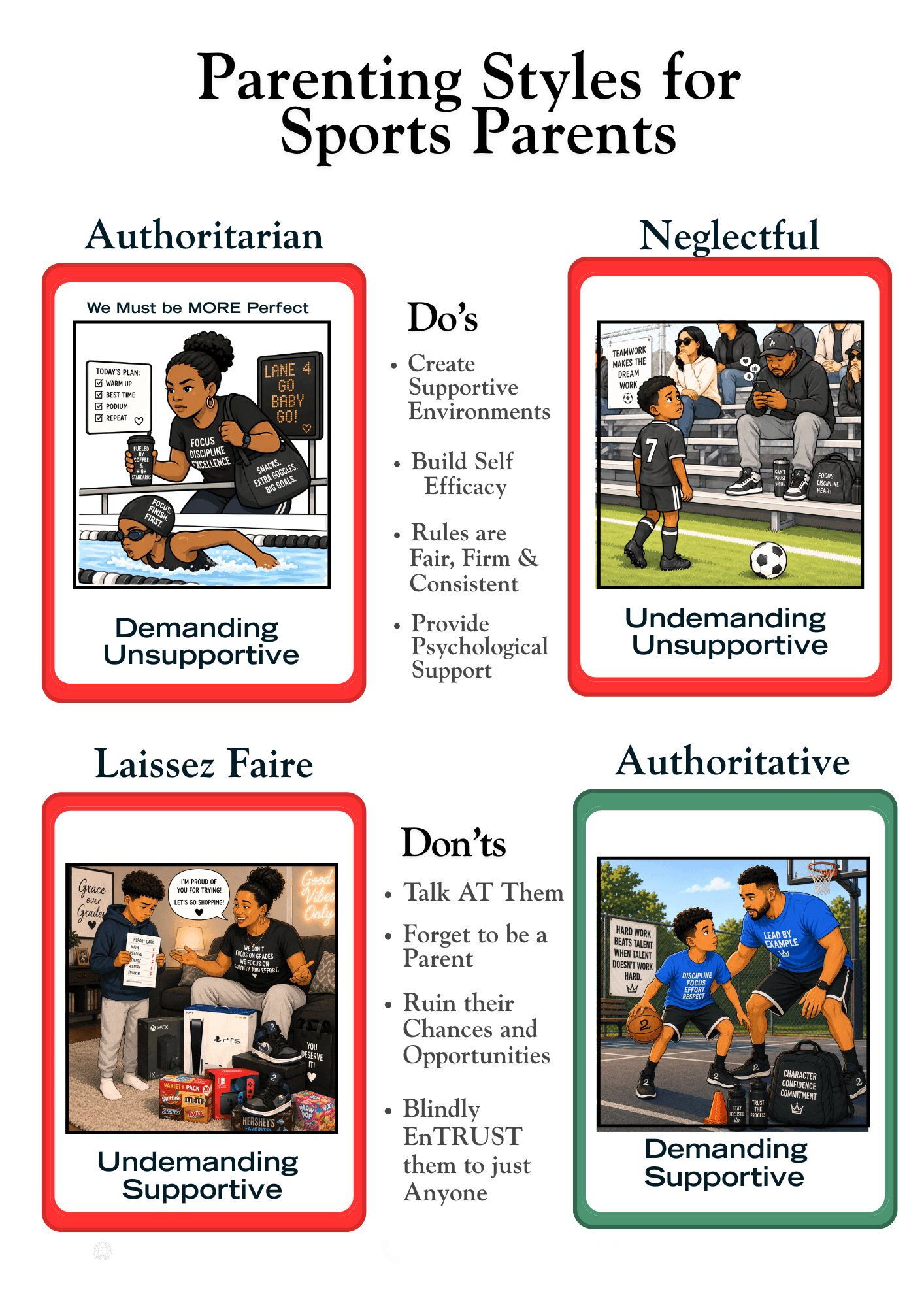
The Authoritarian style is demanding and unsupportive. This is the parent who is a dictator. This is the parent who gives stern directives without the possibility for questions. Amy Chua’s book, The Battle Hymn of The Tiger Mother, showed an unrelenting pursuit of excellence with extreme tactics and schedules. This style can be effect, but often produces burnout and resentment, even if “success” does manifest. This is often the parent living vicariously through their children.
The Neglectful style is undemanding and unsupportive. At best this is the absentee parent that is uninvolved. At worst, this is the parent whose behavior is emotionally or physically harmful. This is the child who looks into the stands to see no one cheering for them. The coach often becomes a surrogate parent to help fill the parental void.
The Laissez-Faire style is undemanding but supportive. This is the parent that has no parental boundaries. This parent is either indulgent, or the parental roles have reversed where the child is actively parenting. This is the person who presents as the “cool” parent because of the non-existing boundaries. This is more common in the days of Name, Image and Likeness (NIL) compensation, where children become primary income earners, roles can be reversed very easily.
The Authoritative style is demanding and supportive. Even Amy Chua realized that there needed to be some boundaries to increase well-being and self-efficacy. This style pushes the limit without pushing the child off the proverbial edge. Parents like Richard and Oracene Williams, who can balance heavy training schedules, education, age-appropriate activities, self-esteem, and surroundings that support the holistic self, create a Serena and Venus.
Well-balanced children turn into well-balanced athletes. Well-balanced athletes are equipped to deal with the pressure and the highs and lows of the game; in addition, to the fundamentals of heavy training and body maintenance.
When I worked for The Milwaukee Bucks of the National Basketball Association, I used to tell the prospective candidates two things. First, the hard work that got you invited to the NBA combine will not be enough to sustain you in the NBA. Second, I emphasized the need for talent and character. The formula for championships requires more than just talent for sustained success. Sadly, by the time the athletes reach this level, it’s difficult to implement the psychological skills (e.g., mental toughness) especially if there is no true base to build from in the athlete’s skill set.
Negative Effects of Parents
Parents who only emphasize training or are focused on that elusive pot of gold at the end of the athletic rainbow; may never see that dream realized; or it may come to a premature end if they neglect the psychological well-being that promotes a high level of self-efficacy. Most important, remember your behavior is the biggest predictor (McLeod, 2025). We’ve all seen parents whose behavior and energy demoralize their child, ruins the game for the spectators in the crowd, negatively impacts how the coaches and referees interact with your child. Further, it hinders credible universities, agents and teams working with your child. Lastly, it can affect your parent-child relationship long after the sporting career has ended.
Positive Effects of Parent
Children learn by observing and looking early in life. Parents must recognize they set the foundation in these early years of life. 90% of the brain is developed by the age of five years old (Cook et al., 2003). A parent with positive skills will help their child to understand that the sport they play should provide excitement and joy. Next, the parents should ensure the sport lessons are generalized into life lessons; such as how to build team comradery and emotionally prepare how to win and lose. Sports at its best can open a whole new world for our children. Perks range from travel to the subsidization of college degree. Also, at the highest level it can create lasting relationships and generational wealth for the family. The environment curated by parents for their children matter, especially in the home.
Conclusion
When I’m working with my children, I look for environments that are authoritative in nature. I want them to be challenged and pushed, but I also want them to be pushed holistically. When I work with my children on performance matters, we do three things:
1) We listen to Man in the Arena
2) We go over the three rules
1. Have fun
2. Create goals for the game (e.g., initiate, don’t respond, be a good teammate)
3. Have fun. Yes, having fun is down there twice.
3) We complete an informal post-game performance analysis to see what lessons we can apply to the next game and generalize into daily life.
In these three activities we teach how to set goals, build self-efficacy and strengthen our internal locus of control. Parents, you are the X variable in this equation. Are you leading your child down the path of failure or success?
REFERENCES
Published:


