Share:
Copy link
Copied!

Introduction
“Gnothi Seauton.” Translated, it means know thyself. Who am I? Why am I here? What is my purpose? These questions are asked in every society; in every period of history from ancient Egypt to this new millennium. Mark Twain stated, “the two most important days in your life are the day you are born and they day you find out why?” What Twain should have added was that the why is not a static answer. Who we are, and our purpose is dynamic and fluid. This is why most people get stuck; they allow one portion of their identity to define their entire lives. Sadly, when that prosperous period has ended, those who do not have the mental acuity to transition and evolve find themselves stuck in a reality that no longer fits or serves them to maximize their potential.
Identity Defined
Our identity, our personality, our emotional intelligence is based on a series of events that happen to us throughout various periods of life (Branje et al., 2021). Psychosocial development is the natural progression of life from infancy until death. Eric Erickson developed a theory of psychosocial development in 8 stages, the first three are developed by the age of 5 (Erickson, 1968). This is significant as we talk about our young athletes and their social emotional development, as 90% of the brain is developed by the age of 5. This is the part of the brain (i.e., The Limbic System) that is emotional and triggers our visceral responses. This is the part of the brain that records history (i.e., hippocampus) and dictates our fight or flight response (i.e., amygdala). If trauma, especially compounded trauma, is introduced to this young person, the brain’s neuropathways are altered and this can create problems with 1) attention and focus; 2) ability to regulate emotions; and 3) develop proper attachments (Cook et al., 2003).
This is significant for the young athlete as these are all skills that are necessary to consistently produce at an elite level. Even more, when the fundamentals of the game are taught, we neglect to teach the fundamentals of socio-emotional learning. Are we surprised athletes reject mental performance coaching and mental health counseling at an alarming rate (Reardon, 2021; Reardon, 2023)? We have shown athletes from the beginning what was important and then we try to force this new skill upon them after the training cement is hardened. If we want to build highly successful athletes, we must begin proactively: establishing good habits and thinking with the end in mind (Covey, 2014).
An elite athlete has a complex career arc, but it can be broken down into four stages: 1) Identity Formation; 2) Identity Formed; 3) Identity Foreclosure; and 4) Identity Reformed.
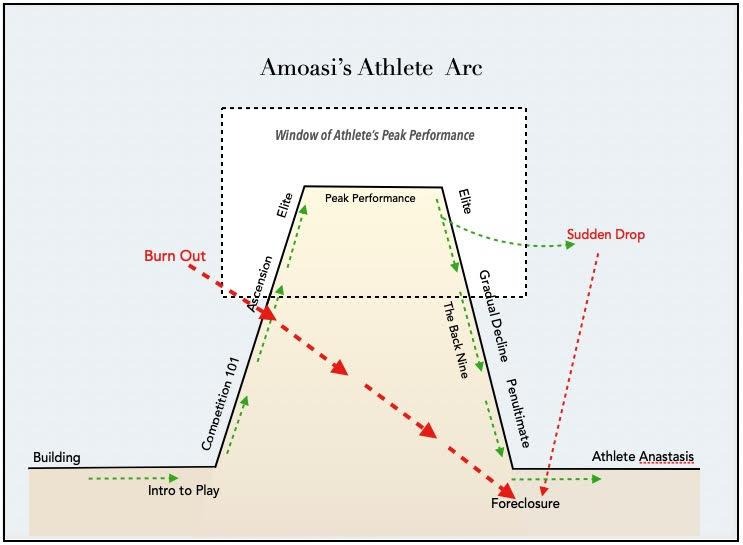
Most people look at this arc, and they start at the beginning. “How do I build a Champion Athlete?” However, if we take a page from military science, we can learn how to win by examining the past. A post-mortem analysis goes over the previous battles, highs and lows, to understand and secure future military campaigns. We must examine the athletes of yesterday and today to build the athlete of tomorrow. We must reverse engineer the success stories and cautionary tales of current athletes and combine that with the unique circumstances and identity that everyone brings to the playing field.
Identity Reformed
When I work with an athlete, the first task I give them is a written assignment. In this assignment, they are required to write an eulogy. Why this assignment? It tells me three things: 1) What are the goals they want to achieve over a lifetime; 2) It lets me know the depth and breadth of their dreams and imagination; and 3) It helps me to understand what other parts of their identity they recognize outside of their sport identity. After the first written draft, we explore these items and then we begin to clarify what they want from life. Especially outside of sports; as many athletes only talk about athletic achievements initially. As we delve deeper into the assignment, I query, who would you thank? More importantly, what would they say you accomplished after you retired? What would they say would be the legacy you left in the world?
In the movie King Richard, Richard Williams understood he had two prodigies, but the world of tennis would eat them up if they weren’t protected in different ways. Between their father, mother and big sisters, they understood the importance of family, protection of childhood, and having talents and interests outside of sports. Venus and Serena did it unconventionally and it worked out well for them, but not before the rest of the sports world mocked and ridiculed, both them and the family. ESPN’s 30 for 30: Broke, highlighted athletes who lost and squandered millions because of frivolous spending, over generosity, and parasitic predators who took advantage of their ignorance and naivety. We can learn from both examples.
In Michelle Obama’s book Becoming, she highlights the psychosocial development of adults and the constant evolution for each new stage of life. The truth is one day you will leave the sport: 1) on your own will; 2) be forced out; 3) leave due to burnout; 4) injury; 5) diminishing skill, or 6) loss of love for the sport. One day the final whistle blows! You can think you are prepared; but change is difficult for the prepared and terrifying for the under and unprepared.
There is a Japanese proverb that states: “fall down seven time, stand up eight!” This is the mantra of the elite performer. They understand every situation is not going to go the way predicted, but the true essence of a champion is in the response to an unfavorable situation. The work ethic that takes an athlete to the pinnacle of their sport can help propel them to success in their next domain to conquer. The athletic anastasis is the literal resurrection, rising from the dead, the resurrection, standing up again. There is a Mexican proverb, with Greek roots, that states “They buried us, they didn’t know we were seeds.” That’s the beauty of sport and competition. It teaches resilience and perseverance. It builds character and competence. It builds a competitive edge that does not understand defeat or surrender. This is why some parents place their children in sport, to refine their character and resolve. A champion, even a fallen champion, holds the formula to the keys of success. Hard work transfers to every sector of life. The challenge is to find something that the athlete can love with the same intensity that compelled them to go the extra mile. This is why it is imperative to prepare athletes for the closing window of peak performance, in advance, as that is the proverbial fork in the road for future hard times or success.
Identity Foreclosure
What is problematic in the sports world is that identity foreclosure, the end of an athletic career at an elite level, can come with a double smack. First, the loss of the sport they love and how it defined them; secondly, the looming mystery of what is next and who they are outside of sport. Athletes with a multi-dimensional identity fare better than those with a low multi-dimensional or exclusive athletic identity (Seo & Reifsteck, 2026). How do we solve this problem? How do we help transition them into an athletic anastasis? We have multiple answers, here are three easy options to start the healthy transition:
Build Multi-Dimensional Identities: Parents, coaches, schools, and governing bodies must see that the athlete is developed holistically. In school, it is important to emphasize academics as much as athletics (this doesn’t always happen). Every entity that touches the athletes has the responsibility to help them to lean into other gifts, explore other opportunities, build connections outside of the sports world. How can we blame an athlete for only seeing that aspect of themselves if we have monopolized all their time with athletic training and competition. Finally, it is imperative we introduce the concept of mental health coaching early in the training cycle of the athletes.
Termination Preparation: It is essential to educate our athletes to all aspects of the world of elite athletes. There is a beautiful window for optimal performance; however, that window eventually shut. Even inside that window of peak performance; highs and lows still exist in the sport ecosphere; but we must foretell the possibilities of crippling obstacles, mental burnout and gradual decline. And when athletes are at the penultimate stage, we must help them to prepare for the next stage of foreclosure. What programs do we have to help them as they transition out of sport, when they are no longer an asset to the organization?
Non-maleficence: In the medical field, health practitioners take an oath to do no harm or introduce new trauma. Meaning, if you can’t fix the problem, at least let’s not make it worse. The world of sports is brutal between the lines and whistles; but sometimes the wounds come from those who were appointed to guide and protect the athlete. The stories of overtaxing parents, coaches bullying behaviors, medical practitioners molesting players, teammates sexually assaulted by other athletes in the program; capitalistic piranhas and vultures who eat and steal off the wealth of these trusting athletes are well documented.
Identity Formed
For an elite performer, this is the Window of an Athletes Peak Performance. This is when all the hard work has paid off and they have been awarded the accolades and trophies, offered the scholarship(s), made national team(s), drafted into professional leagues, excelled at the highest level, adored by fans with a healthy bank account. This is the spoils of the labor. These are the fruits of dedication, desire, determination, and discipline. The manifestation from the blood, sweat and tears dropped into empty arenas and stadiums when no one was cheering or watching. There is nothing wrong with being proud to be an athlete. Our employment encompasses a large part of our identity and the work of sport is no exception. There is a season for all things, and this season is to be enjoyed like the sighting of Cherry Blossoms in early spring.
There is a sense of accomplishment and pride in going from contender to champion. The athletes arc diagram illustrates a person ascending from prey (novice level) to predator (ascending) to apex predator (peak performance) when they are on top of their game and recognized as among the elite performers in the world. The caveat to the excitement is prepping the athletes on how to take advantage of the elite circles, the business opportunities, the social networking that will prove fruitful when the window of athletic peak performance closes. It is at this time that the athlete’s identity is heavily wrapped in their sport.
A lot of athletes take advantage of this window and dedicate time and resources to being the best, sadly, far too many athletes do not take advantage of this window. When dealing with time, the Greek have a term called Kairos. It is a window of opportunity that knocks for a brief period and the inability to seize it, sees the opportunity vanish into the sea of forgetfulness. For example, a lot of athletes’ post career pain and regrets derive from them not taking advantage of the opportunity at the proper time.
I first started working with athletes in correctional institutions in Wisconsin. These individuals would tell me stories of days of past glory or a potential that was cut short by poor decisions around friends, money, and substance abuse. They took their opportunity and talent for granted when others tried to warn them and veer them back onto the correct track. A danger of this peak performance phase is that a lot of athletes who are at peak playing levels get second chances and are grossly enabled. As they listen and follow the whispers of their own hype they erroneously believe they are above the law. My caution for athletes at this level is this: Organizations, universities and teams will tolerate aberrant behavior if your talent outweighs your trouble. However, as soon as the trouble outweighs the advantages of your abilities, you become a liability that is easy to dispose of tomorrow.
Ironically, a lot of athletes turn left of their opportunity because the sport they once loved and motivated them to rise before the sun has become a burden. That which was a stress reliever has become the stress inducer. My mother once told me, “If you start wrong, then you end wrong.” Now, I think there are exceptions to the rule, but I agree with not getting off on the wrong track and complicating the journey from the onset. There is an epidemic of physical health (e.g., recurring injuries, traumatic brain injuries) and mental health illness (e.g., suicidal behavior and substance abuse, gambling problems, emotional dysregulation, and sexual deviant behaviors) in our collegiate and professional athletes. How did this start? The only way to address a problem is to dissect from its etiology.
Identity Formation
It starts off so innocently. We crawl. We walk. We run. We leap. We jump. We climb. We play catch. We laugh and enjoy quality time that produces mental wellness by simply keeping our bodies in motion. Then we are introduced to sport. There may be dreams and hopes but no guarantee of athletic prowess and success. But, then the child runs, but runs faster. The child leaps but leaps further. The child jumps but jumps higher. This is where the pivot begins and the dreams turn into possibilities. Now the parent invests more resources (e.g., time, money, emotional equity). The silent transition from a game to a career, this is the genesis of the problem. Athletics Canada, The Aspen Institute have produced research that highlights the damage we are doing to our children in the name of love and higher ascension, but yet still continue. Consider the following facts:
70% of children drop out of sports by age 13 due to burnout.
73% of athletes specialize in one sport year-round and is the cause for many injuries at the beginning of their collegiate and professional careers.
Emotional, physical and sexual abuse at all levels is often ignored or gently punished.
Collegiate and elite athletes Mental Health suicide ideation, intention, plans is a growing epidemic. Suicide is the 2nd lading cause of death for collegiate athletes.
Coaches are ill-prepared and/or overworked. Most coaches are not trained in Mental Health First Aid (MHFA) and work with expired CPR certifications. Most coaches coach multiple sports, and average of 1.64 which leads to overstressed coaches.
Some parents are overinvested in their children. They live through them vicariously or identifying them as the savior who will uplift the family from its impoverished conditions. To get an advantage they will reclassify, relocate, and brokage deals to put them in positions of power and control.
There is a lack of socio-emotional learning programs inside the majority of youth organizations. Athletes come into our training grounds with many adverse childhood experiences that are not addressed properly.
The psychosocial development of children, adolescents, and young adults have been, and is still, being negatively influenced by social media, the transfer portal and NIL.
Post career problems of elite athletes, even “successful” athletes are well documented. Significant physical and mental health issues begin to develop or decline as their services are being removed. When these retired athletes recall their stories, it often traces back to childhood dysfunction and a lack of accountability by the organizations that once made empty promises.
Alcohol and Other Drug Abuse (e.g., Vaping, THC), Prescription drugs (methylphenidate and opioids) and performing enhancing drugs are on the rise with many athletes.
How the “business of sport” continues the exploitation of marginalized groups (e.g., race, gender, SES, nationality, and ability) by eliminating the potential to play certain sports and in certain clubs and leagues.
X Factor- There is always a concern that is current, but we do not see as it hides in the shadows. Be aware of new drugs, new dangers, new temptations, new dark forces.
Conclusion
Kasserian Ingera. This is the greeting used by the mighty warriors of the Maasai tribe in Kenya. It means “How are the children?” The response should be Sapatai Ingera, the children are all well!” If the children are not well, that is a condemnation on the adults and society that navigates their matriculation into adulthood. As we discuss the identity crisis inside of our children, we must realize the brokenness inside the system. Everyone involved in youth sport is complicit to some extent. In a capitalistic society, profits generally win over people. There is no quick solution. There is no easy solution. This is a multifaceted problem that will require support from the entire ecosystem.
We understand the importance of movement, play and sports. As children develop an athletic identity, we must make sure it is a well-rounded identity that treats athletes in a holistic fashion; mentally, physically, and socially. Even more, it must treat them developmentally appropriately. We stated that the brain is 90% developed by the age of 5; however, the brain does not fully develop until the mid-20’s (25-28). This is the prefrontal cortex, it controls problem-solving, delayed gratification, and emotional regulation. However, if children are traumatized in the developing years, the brain may never fully develop. And, these are the brains and bodies we expect to perform perfectly and withstand all the brutal assaults that fully mature adults cannot handle.
An athlete’s identity is important to them because they derive a lot of confidence, self-esteem and external validation from their performance. Our job for those who guide them (e.g., coaches, Educators, mental health professionals, and parents) is to allow them to maximize their athletic potential and recognize they are great athletes; but, also remind them they are more than athletes. I remind the athletes I serve that when their eulogy or hall of fame sport is given, the presenter should be able to say, “this person was a great athlete, but an even better human being.”
Published:


