Share:
Copy link
Copied!

Before any biomechanical exercise (e.g., bench press or squat). Before a penalty shot. Before a free throw. We see it repeatedly; an athlete has a settling routine to help them focus for the moment. They do it repeatedly to prepare for the moment until it becomes second nature. Maybe it’s a personal mantra or breath work with three calming deep breaths or a somatic approach where the athlete rubs and blows into their hands to focus on the moment.
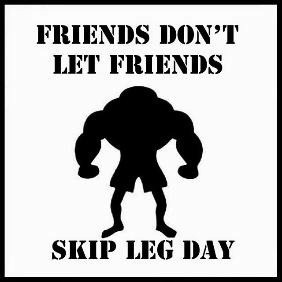
This is brain work! The focus of this article is to expand the mental regiment of the athlete by providing a true mind gym to mentally prepare for the season (Mack & Casstevans, 2001; Orbach & Blumenstein, 2022; Reardon, 2021). It’s comical, but we can see when someone skips leg day by disproportionate muscle development in their upper and lower body. Sadly, there is no visual representation to identify how the brain is underdeveloped by a photograph; but we all witness the underdeveloped mental performance regiment in real time when the mental lapse occurs in an emotional outburst that results in a fine and or suspension.
Purpose of a Schedule
There is an axiom that states, “he who fails to plan, plans to fail.” Most athletes and coaches call on mental performance coaches in the midst or after a crisis, with an urgent plea to fix a problem immediately. There is another axiom that states, “if you stay ready, you don’t have to get ready.” The push for the next generation athlete is to be strong holistically: mind, body, and spirit. Next generation athletes, and those who train them, must understand the need for performance training at the beginning of their physical training (Werner, 2026).
Every coach wants an athlete that is mentally tough, but hoping and wishing is not a good strategy. The same consistency with cardio and strength training needs to be applied for the mental aspects of the game. When A’ja Wilson hits a jump shot in the 4th quarter with the game on the line, does anyone say she was lucky? When Clarissa Shields outboxes her opponent for 10 rounds, does anyone attribute her win to be a fluke? When Trinity Rodman scores multiple points in a soccer match, does anyone think that happened by accident? We understand these athletes put in countless hours to perfect their craft, but that is the physical side. Elite athletes understand their mind needs to be trained in the same manner and do not skip brain day.
Law of Luck
Now how training the brain looks for everybody is different; but there are some best practices that can serve as a skeleton for a guide. And, to answer the question above, A’ja, Clarissa, and Trinity are lucky, but just not as one may think. There are at least four laws of luck:
Dumb Luck: This is for a novice that does something remarkable but does not know how to replicate the magic. It happened once and probably will not happen again or it had something outside of your control. In sports, this is the athlete who is a novice who goes bowling and hits a strike on their first ball, but every ball after plays with the gutter. *Unearned Luck
Practiced Luck: This “luck” comes from hard work. My coach would tell our team: “it’s amazing the harder y’all work, the luckier we get.” In essence, this luck was a law like the law of gravity. If you do the work, the results will come every time without fail. In sports, this is the athlete who pledges to hit the weights every summer and comes back bigger and stronger. *Earned Luck
Luck Finders: There is a Latin proverb that states “fortune favors the bold.” Some people are “lucky” because they look for opportunities. Luck doesn’t just happen; it happens for those who will it to happen. Luck is when preparation meets opportunity. But luck finders, curate a space for these opportunities. In sports, the luck finder is the one who seeks out the shot at the end of the game so they can be the hero; they are the ones who write their own letter to a college coach when no one else has recruited them. *Earned Luck
Lucky Charm: This last level is for those who show the ability to be “lucky” consistently, eventually, other people seek them out to be a part of their potentially prosperous plans. Here you do not look for luck, luck finds you. In sports, this manifests as the reigning champions selecting you to be on their team. *Earned Luck
Routines, Rituals and Regularity
As we understand the laws and levels of luck, we understand the amount of effort to become “lucky,” can be earned by chance, but mostly through hard work and a positive mindset. For peak performance to be achieved by athletes, there must be a requisite level of skill to contend with the increasingly stressful situations. Those who are the luckiest are those who are the hardest workers. The hardest workers have a plan to invite success and not depend on dumb luck.
Those who are consistently “lucky,” have a consistent routine to practice and utilize; more importantly, they are not stressed out the night before a big game. They are not distraught by an in-game mistake. Even more importantly, they have a calming and reframing system when real-life trauma presents itself. Mentally prepared athletes, already have a plan is in place if we have to “break the glass in case of an emergency.” For a consistent routine that allows us to earn our luck, we must satisfy the 5 S’s.”
Five S’s
S.M.A.R.T.E.R. Goals- Routines are established with clear goals. There is a regularity that holds us accountable. Most people are familiar with George Doran’s work with the creation of the SMART goal. That means the goal must be specific, measurable, attainable, realistic, and on a timebound. Good goals are not ambiguous; they are concrete and can be measured in an objective manner. They should be realistic and within your skillset to complete. And, lastly, it should have a timetable to increase our accountability and urgency. For elite athletes we have added the suffice of “er” to make it bolder and emphasize the need to do more than the average to perform at an elite level. What is realistic to the average person is below the threshold for an elite athlete. Therefore, if your goals don’t make people laugh and have them suggesting you revise, you probably aren’t thinking big and bold enough. So, for the E, make your goal Exceptional. Remember, fortune favors the bold. The R stands Radical or Revolutionary. With the platform of elite athletes, the mission is to utilize this platform for something more than sport. When athletes champion a cause (e.g., Autism, Cancer, social justice issues) they bring needed attention and resources. Arthur Ashe and Billie Jean King play was so great on the tennis court that they were able to be positive examples on and off the court as they championed causes of HIV awareness and women’s rights. Dr. Harry Edwards, father of the sociology of sport, was the engineer behind the 1968 Olympic Project for Human Rights. We must be more than the sport we play and leave a positive mark on the world.
Show Up & Show Out-A key part of mental resilience training is to put yourself into uncomfortable situations. Recognizing you belong and are good enough for any room and to sit at any table. Do not be afraid of the word No. Being bold doesn’t mean you will have automatic success, but the sheer will of understanding how to navigate difficult situations will teach you how to turn tragedy into triumph. If we train under adverse situations in practice, we will be prepared to thrive under adverse situations in the game.
Safe Spaces- Even those who are mentally resilient understand the need for protected and sacred circles. Safe spaces recognize the important nouns in your life. Who are the people, places, and things you need to be at your best mentally? Conversely, there are nouns that can be draining in your life. It is imperative to understand who, where, and what you need around you to be at peace to relax or recharge.
Social Intelligence- Safe spaces are needed, but the caution is to not get too comfortable in your safe spaces. We have to be careful and strategic when we stretch our circle of nouns, but we must do it to grow. The key is to remain true to the essence of your character while in diverse settings. This willingness to be open to learning more about the world will increase your knowledge and understanding. Consequently, you will increase your social network and opportunities. Athletes with a high emotional intelligence level are the ones who can serve as team leaders and develop meaningful relationships once they are ready for their transition out of sports as a competitive athlete.
Stick With-Itness- There are a plethora of sports idioms that speaks on the necessity for discipline, grit, perseverance, and resiliency. The military adage states “a steady sea never made a skilled sailor.” The ability to persevere is a necessary tool that is needed in the mental toughness toolbox but can only be developed by going through the crucibles of fire and learning from the daunting experience. Athletes who are brave enough to enter the arena and see it through until the end are the athletes who separate themselves and rise to lead the pack. Helen Keller stated, “character cannot be developed in ease and quiet. Only through experience of trial and suffering can the soul be strengthened, ambition inspired, and success achieved.”
The above list is not an exhaustive list, but in building your mind’s capacity to handle the rollercoaster of adversity, storms, and trials while being adored and achieving high levels of success is not easy. One does not navigate this style by mere dumb luck; rather through a cultivated plan and routine to have an athlete ready and battled tested when the day of adversity arises.
The Schedule
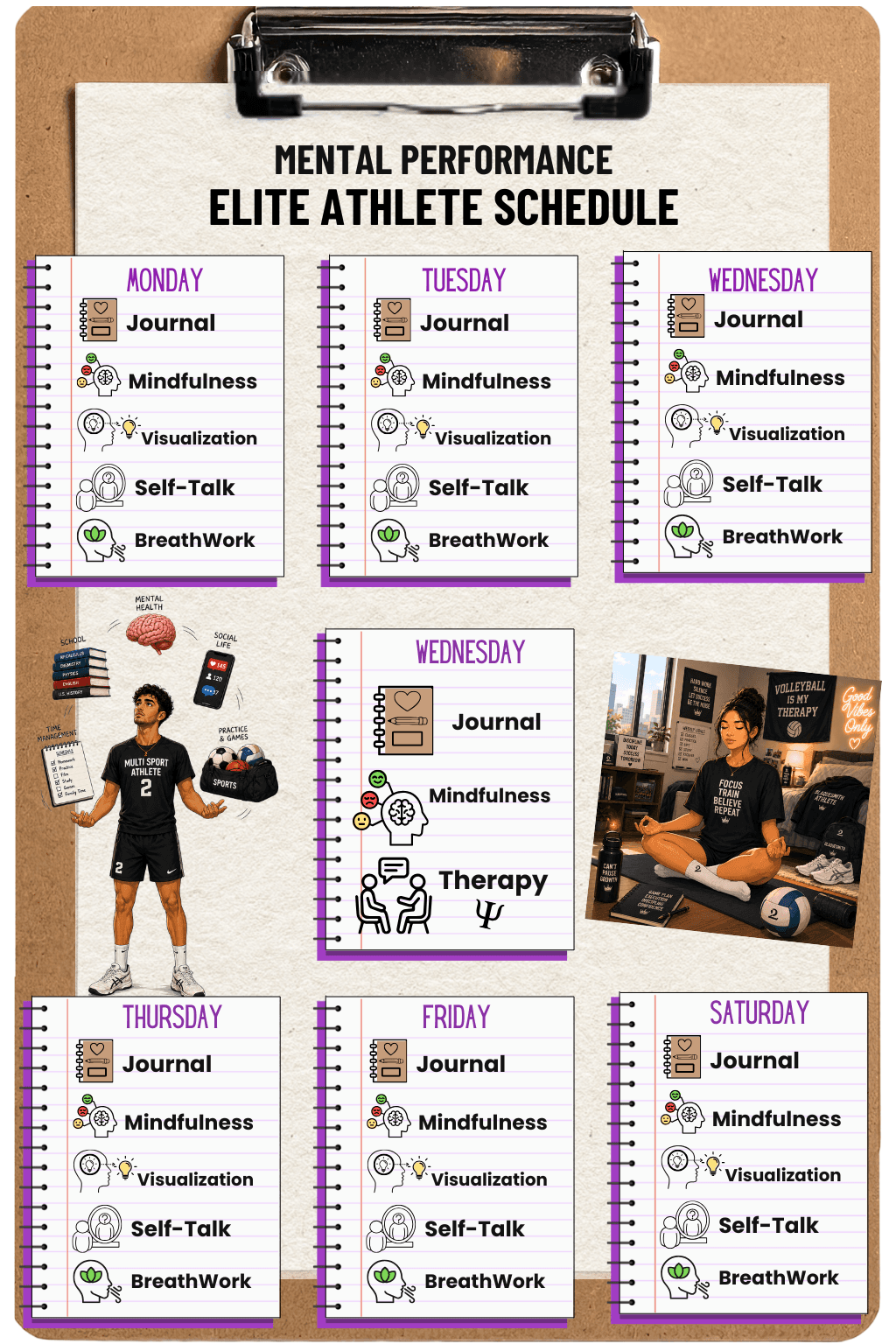
Most athletes are accustomed to schedules, and those schedules are already jammed-packed from the beginning to the end of the day. However, for those who are determined not to skip brain day here is a list to create on Sunday night to direct your weekly workout. We begin Sunday by creating our list for the week and evaluating it for revision at the start of the next week.
There are 3 tools that I believe are beneficial in the beginner’s mental performance weekly schedule: 1) Journaling; 2) Mindfulness; and 3) Therapy.
Journaling
This should be done daily. We encourage beginners to write in the morning and evening. If you are not a writer, consider a video journal on your phone. The question is why should we journal and what should we write?
Why should I write:
Cathartic. That means it is healing. Too often athletes have no place to share their vulnerable thoughts. It is important not to hold in thoughts. When we journal, we engage in self-talk and self-reflection that allows us to identify the issues and move us toward potential solutions.
Goal Setting- This is a great place to set, follow, and track your goals.
Self-Introspection- What you write today may seem simple, but to reread it in one month, one year, or a decade later allows you to chronicle your life and help you understand how you overcame difficulties, accomplished goals.
What should you write:
Start of the week there should be one word to use to set the tone to make you grow and think over the week. I love to use terms from different cultures to stretch my learning.
Kaizen- Japanese term that means continuous improvement The simplicity is to think of small cumulative group. How do I get better by 1% every day.
Itutu- A Yoruba term from West Africa that means “Be Cool” How to remain unhurried, composed and unflappable.
Create a script for morning meditations to set the intention for the day and then end with nightly reflections to evaluate your progress (Seymour, Smith, & Torres, 2014).
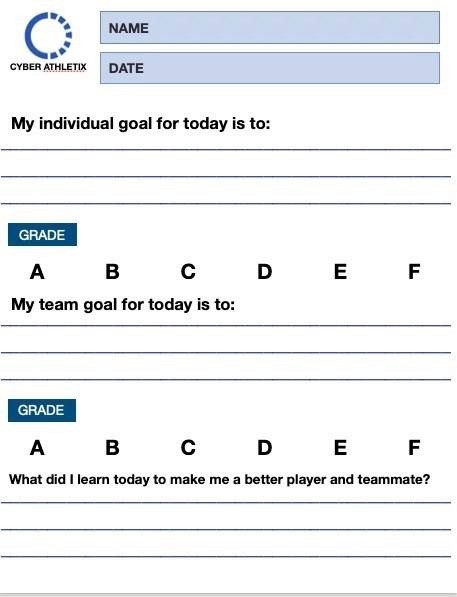
Before and after practice we suggest completing these forms; as they will help you to focus on your mental work during practice. Doing the mental work and physical work simultaneously helps to build the connection to ensure these skills generalize in real time.
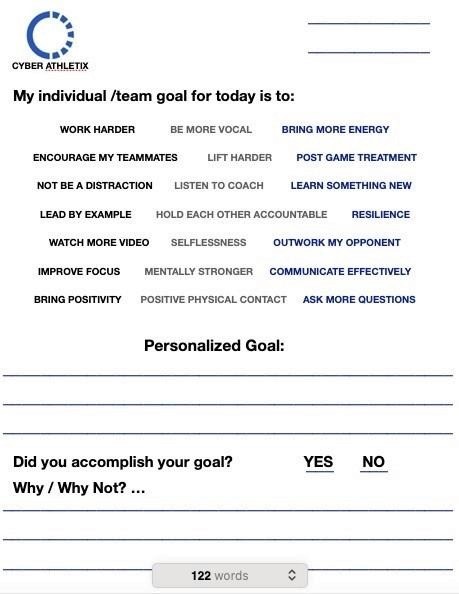
Whatever comes to your mind. You can start with motivational quotes, poems, scripture from ancient wisdom, or what you learned on your favorite podcast.
Mindfulness
How do we stay in the moment? We must cultivate this skill. Mindfulness means to be aware of everything in the moment. Aware of our body, our emotions, our thoughts, our environment, our everything in that moment to be present (Martinez, 2026). Collegiate athletes have shown to benefit from mindfulness-based interventions employed by those within their psychological services team (Wang, Lei, & Fan, 2023). There are many ways to engage in these actions that can help the athlete when a big moment is approaching, and you need to calm your nerves and be present for your big moment.
Examples of Mindfulness:
Prayer or Silent/Guided Meditation (Martinez, 2026)
Self-Talk – This is essential to building confidence and quieting the outside, and inside, voices that want to take us off track.
I Am statements… build a mantra to quietly calm yourself and remind yourself of who you are! Mine is “I am an Unconquerable Champion!”
Learn how to cognitively reframe a negative from the positive. For example, instead of saying, “I suck.” Say, “I can do better next time!”
All time stolen base leader, Rickey Henderson was known for talking about himself in the third person. This technique allowed him to have fun, create space between himself and physical activity, and improved his confidence, and reduce anxiety and tension (Park, Lim, & Lim, 2020).
Grounding- https://milwaukeecourier.com/news/2025/10/18/you-deserve-to-win
(Amoasi, 2025)
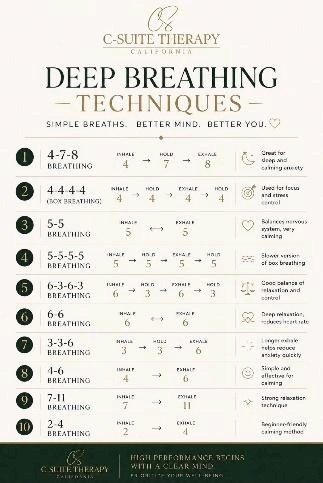
Breathwork – On the website of the Association of Applied Sport Psychology https://appliedsportpsych.org/blog/2025/06/the-commodification-of-breath-parsing-fact-from-fiction-in-the-gilded-age-of-breathwork-and-breathing-influencers/ there is a great article written by Dr. Jim Doorley to discuss how to maximize breathwork in the most natural of manners (Doorley, 2025)
See the figure below created by Ashle J. Childress, LMFT, LPCC of C-Suite Therapy. These breathing techniques are adapted from established pranayama and breathwork practices as developed by Dr. Andrew Weil.
Visualization
Use a VR or Video Game that allows you mental rehearsal
Imagine Yourself in the Moment
Rewind through film study (or your memory) remember how you felt in the moment. What do you need to do differently? What would you keep the same?
Imagine failing. Take away the fear. Then….
Imagine succeeding and replay that visualization scenario at a 3:1 ratio to the former.
Therapy
According to the World Health Organization (WHO) 1 in 7 people live with a mental health disorder, with anxiety and depression, the most prevalent. When these issues are left undiagnosed and untreated, individuals and families suffer; job performance decreases; and suicidal ideation and plans become more likely. As it relates to athletes, the situation is even more perilous. Many athletes suffer in silence from issues related to and outside of sport and this is exacerbated for athletes from marginalized and underrepresented demographics (Brown et al., 2021; Gouttebarge, et al., 2019; Panza et al., 2022; Reardon, 2021; Wilkerson, et al., 2020).
Not all athletes deal with clinical mental disorders; however, every athlete can benefit from having a performance coach. The key is to find the correct person with the proper certifications and credentials.
The Association of Applied Sport Psychology has the premiere certification in North America. You can find a consultant at https://appliedsportpsych.org/certification/cmpc-directory/
The Alliance of Social Workers in Sport also provide a Sport Social Work Professional Certificate. They can be contacted at https://www.aswis.org/
Positive Coaching Alliance is another resources for coaches. https://positivecoach.org/the-power-of-positive/?gad_source=1&gad_campaignid=19654733744&gbraid=0AAAAADlKi02b9sSXOQHAV4TNSNpVhBkrR&gclid=EAIaIQobChMIvuOgiL-vlQMVECfUAR1eOgOfEAAYASAAEgIwGvD_BwE
Former athletes, such as Kevin Love, with lived experiences are also stepping in a revolutionary way to break the stigma and help educate the public. https://positivecoach.org/the-power-of-positive/?gad_source=1&gad_campaignid=19654733744&gbraid=0AAAAADlKi02b9sSXOQHAV4TNSNpVhBkrR&gclid=EAIaIQobChMIvuOgiL-vlQMVECfUAR1eOgOfEAAYASAAEgIwGvD_BwE
Many programs focus on building skills and training the body but few put emphasis on the mental side of the game. It is essential parents partner with programs like Cyber Athletix who put as much emphasis on the mental side of the game. https://www.cyberathletix.com/
Published:


